Create
Your site or app creates a payment session with the order reference and approved payment choices.
Operational checkout for businesses in Pakistan
EPS is a commercial payment gateway in Pakistan for online merchant checkout, payment status, refunds, and settlement visibility—one connection from customer action to finance-team record.
Pakistan coverage for approved merchants may include JazzCash, Easypaisa, NayaPay, Raast, and Bank Alfalah routes. Method availability, fees, settlement timing, and production approval are confirmed during onboarding.

Merchants need the payment result to remain useful after the customer leaves checkout. EPS keeps the order, transaction, refund, and settlement story connected. Read the merchant payment gateway guide.
Your site or app creates a payment session with the order reference and approved payment choices.
The customer completes the selected flow and the transaction returns an approved, pending, failed, or declined state.
Your server verifies the result before an order is marked paid, fulfilled, or held for review.
Transactions, refunds, and the applicable settlement record remain available to the merchant operation.
A clear state model helps customer support, operations, engineering, and finance look at the same transaction without guessing what happened.
See the integration pathsCustomer methods can differ while the merchant-facing lifecycle stays consistent: authorize, confirm, reconcile, and support.
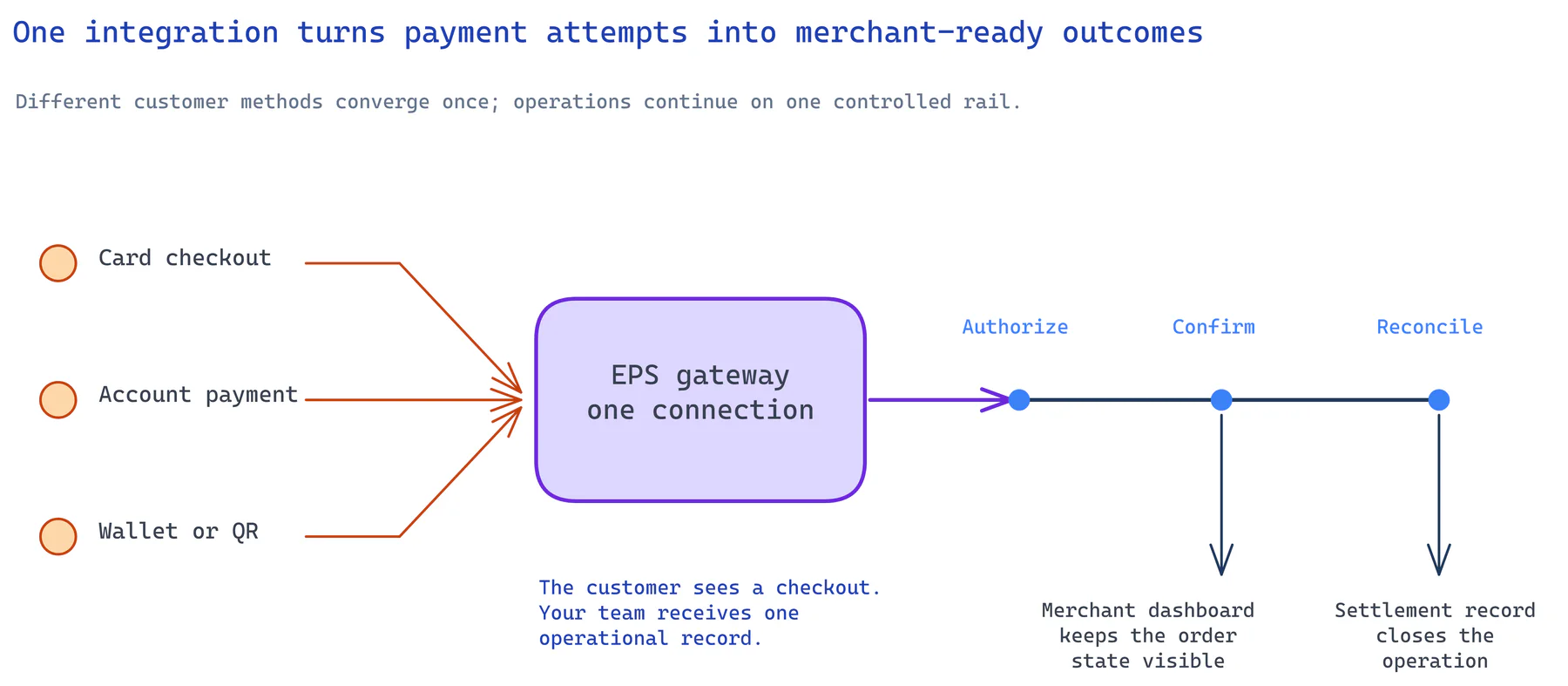
Choose the lightest integration that returns a reliable order state. Move to server APIs and callbacks when reconciliation, refunds, or platform workflows require more control.
{
  "order_reference": "ORDER-1042",
  "amount": "12500.00",
  "currency": "PKR",
  "return_url": "https://merchant.example/return",
  "callback_url": "https://merchant.example/payment-status"
}Pricing, integration effort, risk controls, and business-model fit should be reviewed directly—not hidden behind generic feature promises.
Methods, volume, refunds, implementation scope, and settlement requirements are reviewed together.
Review pricing inputsAn ecommerce order, school fee, booking, and platform payment do not create the same operating work.
Find your operating modelCredentials, signed events, role boundaries, test cases, and incident paths are part of go-live readiness.
Review the control modelThe merchant integration should verify transaction state before fulfillment, protect credentials, keep event evidence, and separate test activity from production access.
Read the security approachUse HTTPS and controlled endpoints for every payment request and callback.
Verify the source and integrity of payment-status updates before changing an order.
Limit production credentials to the systems and people that genuinely require them.
Concise answers about eligibility, payment methods, integrations, pricing, settlement, refunds, security, and onboarding.
A payment gateway in Pakistan connects a merchant checkout to approved payment routes, returns a transaction status to the order, and provides the references needed for refunds, settlement, and reconciliation. EPS offers this as a commercial merchant service rather than a consulting product.
EPS is presented as a commercial payment-gateway service. The site is designed to move eligible businesses from evaluation to merchant onboarding, not to sell advisory reports.
Ecommerce stores, service businesses, education providers, retailers, platforms, and other registered businesses can request a review. Final eligibility depends on the business model, documents, KYC and AML review, and required payment methods.
For Pakistan, approved merchant projects may enable JazzCash and Easypaisa wallet flows, the NayaPay e-wallet, Raast instant transfers, and account-based routes through banks such as Bank Alfalah. The exact method mix is confirmed for each merchant before launch.
A merchant can start with a hosted payment page or connect through server-side APIs. The backend creates the payment, verifies status, and processes signed postbacks before an order is fulfilled.
Yes. The merchant backend uses the approved API key and project ID to create and verify payments, while signed postbacks provide asynchronous status updates.
Pricing is quoted after the team reviews payment methods, expected volume, refund needs, integration work, and settlement requirements. No public rate is promised before that review.
Settlement timing depends on the approved merchant profile, payment method, banking route, risk controls, weekends, and holidays. The applicable schedule is documented in the merchant offer.
The integration is designed around explicit payment states so the merchant can distinguish approved, pending, failed, and refunded transactions and keep order handling aligned.
The service design uses encrypted transport, signed server requests, controlled credentials, event logs, and integration testing. Any formal certification or scheme eligibility is confirmed separately during onboarding.
The EPS team reviews the company, website, products, preferred payment methods, integration route, and expected volume, then returns the next onboarding and technical steps.
Tell EPS how your business sells, fulfills, refunds, and reconciles. The merchant team will map the next commercial and technical steps.